2.02.2007

Harry Potter and the Strictures of Statutory Rape Laws

I've been all about Ron, but this horse might just turn me around on who the real wizard is. Ahem. Seriously though, this play looks like some magical intersection of Harry Potter, The Neverending Story, and Velvet Goldmine. If only I wouldn't have to go slumming on the West End to see it.

What a stallion.

1.28.2007

Sundance: Part II

Great piece in the NYT today about Sundance from the actor's perspective, and more specifically from the people who keep cropping up in "indie" films. So, I found this interesting for a lot of reasons with the biggest one being that I do think of indie actors as having their pick of interesting material, and only picking projects they care about. I'm actually glad to find out that's not true, although the reality of it is driven by studios, profit margins, etc. which is not so great to think about. I like believing that Sundance is still a creative lab of sorts for writers, directors, and actors to try their hand at telling more compelling stories.

The article mentions the reputation of Sundance changing because of this:

"Further complicating matters, an ever growing number of Hollywood A-listers regard Sundance as a kind of boutique spa where they can order up an image makeover."

Truth be told the films that come out of here with the biggest buzz usually have the star factor going for them, but bottom line I think this article validates the work of Sundance in a way it hasn't been thought of in years.

Also, a sidebar response to my last post about the Oscars. I actually think the Cannes festival does a much better job of representing the best things happening in the film world. Past winners like Almodovar, Wong Kar Wai, and Michael Haneke have proven it. A quick look ahead to Cannes '07.

1.25.2007

P.S.


Now that my wisdom about the Oscars has been doled out it's time to turn our attention to what's happening with movies right now. It seems like Sundance gets more reviews then the movies that premiere there.
For a good look at what's going down at Sundance check out indiewire where the bloggers are living the real dream.

Dreamgirls is out and a little flick with Steve Carell is in--How the Oscars got it right

Okay, so it's old news to a lot of us by now but the Oscar nominations this week were pretty interesting. Although it has already been written about pretty extensively I am excited that Dreamgirls didn't get any major nods. It is a movie I snoozed through the first thirty minutes of, and then had to witness audience cheering and clapping (a sensation I find oddly shameful) for the remaining couple of hours. It wasn't particularly innovative or thoughtful, and if anything it was calculated and inadequate in its attempt to cover an important period of time in broad historical strokes. So, even though my blogging wisdom told me that DG shouldn't be nominated I didn't expect the Oscar nominations to reflect that. More importantly I didn't expect them to acknowledge the best movies of the year as well as they did. I like the distribution they gave to a wide range of films--that's about how I would assess this year, and frankly it's a lot more interesting then a hands down frontrunner. Furthermore, I really like that Little Miss Sunshine got a big nomination because I think it is the most disarmingly clever film I've seen this year. It had a lot to say, and used a really discrete scenario to raise a lot of important questions.

As for why any of this matters (because we know movies don't need awards to validate them. i kid...i kid) I really believe that anytime the mainstream embraces a trend that is positive it's a good thing. In the grand scheme of things a nomination isn't so significant, but it does slowly chip away at studios desperate to push our pre-determined emotionally simple buttons.

1.04.2007

Because in '07 we roll en espanol.


The three best movies of '06/'07 depending on the movie sophistication/distribution factor of your city? Volver, Babel, and Pan's Labyrinth. Okay, so I haven't seen the last one yet. Turns out my city is about a 5 on the movie rube/sophistication factor scale. Doesn't matter--all my instincts tell me (and by instincts I mean watching the trailer one too many times) it's going to be awesome. If you don't believe me check out what the NYT's carpetbagger blog has to say about it. For those of you too lazy to follow the link it says said movies are awesome.
P.S. Any guesses as to what this is a picture of?

12.11.2006

Everyone's a Critic.

An interesting year ending tally. Does the list demand allegiance?

12.02.2006

The Face of New Media.

So, I know I'm a little (read A LOT) behind the general masses on this one, but I read the piece in Wired this month about the Lonleygirl15 phenomenon on Youtube. It's a pretty good piece, and it raises a great question--how will content designed strictly for the interweb differ from film/tv prototypes? The creators of Lonelygirl seem to believe there's a kind of authentcity to the handheld single cam focus with the assumption being that the subject is filming themselves.

After checking out a few videos on their site--www.lonelygirl15.com/ I'm not sure I understand how their format would translate with different genres? In particular I'm thinking about how their typical episodes last roughly 2 1/2 minutes, and are released every couple of days. This clearly equal low production value, but take it past the "dear diary" format and I'm thinking there would have to be loads of changes. Also, while I can see how some of the lighting, props, camerawork, etc. would have to be downsized for the average computer screen I think some cinematic features should be preserved. Just case it's on the web doesn't mean it has to be low budg and guerilla-like. On the other hand what do I know? The amount of comments the lonelygirl15 eps. get is pretty amazing averaging about 300 comments each time, so we're talking about at minimum 1,000 unique hits each week (and I know I'm lowballing that figure big time). Clearly the interweb masses have spoken.

11.28.2006

When capturing the eye matters.


Just finished watching two movies that I think are doing really spectacular visual tricks in film worth pointing out. They've got me thinking about how film is an attempt at marrying verbal narratives with visual ones, and just how rare it is when these two goals actually meet. Now, arguably the two films I want to write about--Water and 2046 don't necessarily achieve both of these. However, their visuals are so arresting that I found myself obsessed with each shot, which is something I've never been able to say about a movie before.

First off, it's worth noting who the cinematographers are behind these projects although directors Deepa Mehta and Wong Kar Wai deserve a great deal of credit for how their projects turned out. In 2046 it's Christopher Doyle who, based on a quick IMDB scan is probably best known for his work on Hero, and with Water it's Giles Nuttgens who was behind the other two films in Mehta's trilogy and most frighteningly was also behind the lens in Battlefield Earth. However, I'm willing to forgive given how beautifully he composed the shots in Water, a film that could've easily rested on its somewhat controversial narrative, but instead chose to capture Varanasi in a kind of constant pre-dawn glow that was stunning. The approach to visuals in both films is different, and this makes sense given the content of each film but what I really appreciate is the commitment to giving the viewer something really powerful visually, which, as silly as it sounds given the medium is really unusual. Of course I say 'unusual' but that's pretty strictly in the context of studio films. I haven't seen nearly enough alternative cinema to know what kind of visual palettes are out there, but suffice to say for popular cinema these two are pretty groundbreaking.

In getting down to the nitty gritty of their visual approaches I found Wong Kar Wai's really fascinating because he works without a script. Beyond the turmoil that probably creates for the actors I suspect it means he relies on visual depictions right off the bat to create mood. One of the great things about this film is how it shifts from a color saturated, sleek futuristic Hong Kong to a sepia toned nostalgic one set in the 60's without missing a beat. So much of the romance that pervades the film comes from his shot composition, which I can only describe as elegant. They are in no way flashy, overdone, or simplistic; instead they are composed so carefully with pure aesthetics in mind. Because there is a time shifting/dream like nature to the film there are a lot of shots where an object sits in the background, and we get something seemingly less significant like flowers blurred in the foreground. I think another way to describe Doyle's work is precise, which is not to say that the film is efficient by any means but it doesn't feed us unnecessary visual stimuli. I think Wong Kar Wai has enough confidence in his vision not to overstimulate while at the same time completely overwhelming the viewer with the power of film.

With Water I think there's a similar precision at work although some of the visual motifs used to depict romance feel more familiar and typical. The colors at work in these shots are intense and pure, which works really well given the stark white costumes of the widows. Because the narrative economy of the film is pretty spartan it is often the more inconsequential shots (to the storyline) that carry the most weight. There are phenomenal images of rain, lakes, and small beaches that make the geography of the story present in the film. I think a story that has the emotional and political impact of Water is clearly one that needs to be told, but when we are treated to a true cinematic experience in which the director and their crew are clearly interested in maximizing how that narrative is delivered we're lucky.

The question of how to credit visual work in film is interested because it is a collaborative project, and clearly no one person is responsible for everything that we get. I tend to give the director most of the credit, and that's probably not fair, although the title of auteur is one used frequently with both Wong Kar Wai and Deepa Mehta. I bow down to both of them for giving me something great to wrap my brain and my eyes around.

10.28.2006

The Sens(ibility) of Inland Empire

Just a few weeks ago I got to catch the premiere of David Lynch's new film Inland Empire at the New York Film Festival. After waiting in life for forty minutes at Lincoln Center...voila we had scored $10 tickets to a movie that, at that time had yet to find a U.S. distributor and was more or less considered the hottest ticket at the Festival.

So, to be fair I missed the first forty minutes due to a last minute meeting but for a movie that finished up at 172 minutes, and was fairly incomprehensible in the 132 minutes that I did catch I don't feel like I missed out on much. Was it amazing and mind blowing you ask? Is Lynch's foray into DV opening up the medium? Was he able to outdo the weirdness that was cowboy and the midget from Mulholland Drive? Shockingly, the answer to all of these questions is yes, and while I'm not sure I saw a good movie or a movie that I enjoyed I did get to see David Lynch, Laura Dern, and Justin Theroux a mere 10 feet in front of me!

As for the movie I'm not sure I could or want to try break it down narratively. I'm more interested in the questions it raised for me more generally. One of the interesting questions that cropped up during the Q&A after the movie was whether the film could come together in a coherent form for the viewer? To which Lynch (rather charmingly I thought) responded "Of course". I now actually believe he sees his visions as pretty clear and comprehensible, which I suppose any artist would; otherwise why bother conveying it. He did mention that there was a dream logic at work, and loose a term as that is I think it's an apt one for the narrative disjunction in his films. The one thing we can all confidently say about our dreams is that something is threading them together, we just can't always articulate what that is.

As a viewer I wonder what to do with a film like Inland Empire that has a couple of identifiable themes (simultaneous seduction and ephemerality of Hollywood, subjection and objectification of women) but it's not really clear what he's doing with them. In this case Laura Dern plays multiple characters who start and end with dreams of success in Hollywood. In between are a slew of characters that stumble in and out of her life and her dreams with a couple of male characters being exceptionally crude and offensive. One thing I question consistently with a director like Lynch, who clearly aims to break new aesthetic ground in cinema is how the audience should treat the final project? Is it a piece in a larger artistic endeavor or can we pick it apart on its own merits and failures? I think this is especially important because we are always looking for people to push boundaries and make something new, but I think the key here is relevance. I'm not sure he always achieves it.

As far as form goes the quality of DV is pretty weak. Although there were a plethora of interesting shots, set pieces, and music the overall look of it was pretty grainy and mottled. However, both Laura Dern and Justin Theroux talked about the kind of freedom they enjoyed as actors, because the camera was always rolling, and they didn't have to reshoot from multiple angles. I could see this being a really great tool for directors and actors alike, and changing the medium for those very reasons.

I will just say that despite how confusing I find Lynch his influence is undeniable. After watching a few episodes of Lost recently it's clear how much it benefitted from Twin Peaks.

~The end.

10.26.2006

Bow down to Borat


So, if the premiere is any indication this movie is going to be diggety dope. That's right EW it will be both the funniest and most offensive movie out this year. Those things actually co-exist pretty easily.

10.18.2006

Hume or Kames? You decide.

There's a really great piece in last week's New Yorker about the predictability of movie box offices by Malcolm Gladwell. The question at the center of this debate is one I find fascinating: Are there a quantifiable set of factors that make a movie a success for the vast majority of audiences?
Or is it as Scottish philosopher David Hume would have us believe...

"Beauty is no quality in things themselves, It exists merely in the mind which contemplates them; and each mind perceives a different beauty.”

According to Gladwell's profile the motley trio of Epagogix is on the side of Kames--not only can we quanitfy these things, but we should, and make box office numbers the literal bottom line of filmmaking.

While I'm equal parts fascinated and horrified by this approach (the fascination really stems from my lack of quant skills) what I'm really curious about is how much the little factors play into the success of a film. The example in the piece cites The Interpreter, Sydney Pollack's relatively unsuccessful film set in the U.N. According to Epagogix the choice to set it in a pseudo African country, the inability to capitalize on the romance of the U.N. as a location(what the frak? since when did bureaucrats equal romance?), and too much ambiguity made this film a failure.

So, is it really this logical? A good film is quantifiable? The article noted this approach is already used with relative success in music, but I wonder if this could or would ever extend to other artistic modes? I suppose music and film are the most overtly commercial, and thus lend themselves to this approach pretty easily but I still can't accept this notion. Ultimately I think it suggests that there is no ambiguity in art and that, as anyone who has ever been overwhelmed, perplexed, annoyed, shocked, etc. by a movie or a piece of music will tell you is just not true.

10.15.2006

Been to the movies lately? Nah, but I'm not sure I could tell you why.


Okay, so I'm not diagnosing it as an official problem yet but I haven't seen a movie in months. Well, that's not exactly true because I did recently attend a MAJOR movie event (soon to be blooged about), but it was an anomaly in an otherwise dry period for me. So, naturally being the curious person that I am I have to ask myself why? Why would a person who loves movies stay away from them for the last few months? It's not even like it's the summer blockbuster season. There are actually good, even great things out right now and I just haven't been motivated to see them.
Even more strange I find myself not wanting to see the movies that people rave about/I'm confident will be good. Exhibit A--Little Miss Sunshine, a movie that had quality entertainment written all over it. The trailer looked great, it had a great cast, and everyone I know who saw it said it was good, but the more I heard about it the less I wanted to see it. Now, I chalk some of this up to a general desire right now to be perverse, but I think there is a deeper reason for my lack of movie interest. Part of it is my larger commitment to television right now (I feel like the big networks have rolled out one of the best seasons ever content-wise) and the other part of it is a growing fear that every movie I want to see won't really be satisfying.
Exhibit B--The Science of Sleep, a movie I've been reading tons about and whose director I adore. So, why haven't I seen it yet despite the fact it's playing roughly 1/4 mile away from where I am right now? The answer is as simple as it is silly: The longer I go without seeing a movie the more fear I have about the one that will break the spell. Will it be good enough? Will it entertain? Will it re-energize my love for movies?

Well, you can see the conondrum here...and I suspect there is only way to solve this one. Tomorrow I'm going to the movies, and hopefully I'm going to laugh, cry, and fall in love with them all over again.

9.21.2006

T-10


10. an ode to the movies made in my favorite texas city. the one i'm most proud of? toss up between the chainsaw massacre and varsity blues...that's what i call texas culture.

9. the best music to movie crossover...oh wait this is never a good idea

8. best tv to movie crossover . or the most tragic one depending on whether you loved her television work?

7. all jane austen adaptations cause the only thing better then reading austen is watching austen. how many authors can you say that about?

6. 1/2 of wes anderson's work (the first half in case you're wondering)

5. batman begins ( i think this blog is actually a poorly concealed ode to that movie)

4. every critic that's ever written something amazing. lane, thomson, scott, dargis, turan, chocano, and zacarek.

3. bars that play movies on a giant screen.

2. anyone i've ever talked movies with.

1. 25 years of life - 7 (years when i wasn't watching movies due to time devoted to developing brain--i.e. reading, writing, hand-eye coordination, etc. and living in a country w/ access to only french and arabic stuff) = 19 years of movies. best.years.ever.

9.19.2006

....and counting

19. the 400 blows/my obsession with French new wave (which only lasted as far as Truffaut). this was a seriously great simple movie, which even my dad who has no patience (a.k.a. falls asleep in movies at a rate faster then even me) liked.

18. my own brief attempt at movie making, in which i learned no editing equipment/knowledge of editing means no movie will be made.

17. during a particularly dry fund summer i (and others who will remain nameless) was desperate for the movies and tried to swing the kid ticket, which really should've worked given how young i'm often mistaken for being. it didn't work and yes we were ashamed.

16. the metacritic stinker alert--this list is pretty revolting

15. discovering that jlo and mm are perfectly suited for a romantic comedy together...they have never made anything as good as this and they never will....

14. trailers (i defer to apple on this)

13. a movie so bad i actually walked out of the theater--gattaca. also, you have to love something that can provoke that serious a reaction out of you.

12. my own special day of torture as an extra in a movie...i was promised a SAG card, i swear.

11. SXSW the hippest festival for movies cause they're not front and center.

10 more to go...

9.17.2006

To the quarter life....

Since my mind has turned to the number 25 this week I've decided to devote this week to 25 reasons that movies have thrilled this 25 year old's heart. Also, let's see how many times I can throw 25 into every post...maybe all the repeitition will help my weak memory realize that I'm getting older.

25. Netflix--cause what's better for a lazy person then getting movies delivered to your door?

24. Quoting lines--yep, it's social insiderism at its worse. people quoting without reference and expecting a reaction (often the next line in the movie, but sometimes a laugh will suffice) because they get cultural moments. guilty.

23. snickering my way through Titanic, and my first realization that Hollywood romances are weak. sidebar--whose genius idea was it to get James Cameron to direct one? i don't remember many tender moments from T1.

22. seeing the English Patient at 15, and being firmly convinced that not only was this a clear sign of my sophisticated taste as none of my friends had seen it, but also getting the thrill of sneaking into an R rated movie.

21. the failed triple feature...one night...three movies...two of them were bad and sustenance was low by the third one. this one's really a testament to my friend A and I who were intrepid enough to try, though failing and literally falling asleep on different rows by midnight.

20. going to MGM studios when i was 13 and learning that they made fire with sheets and fans--way too much for my formative mind to handle.


okay, i'm running out of time today but more to come.

9.14.2006

A movie about my life...in three parts.

So, maybe it would start with this old gem...then progress onwards to my current state best summed up by this with an even more current dose of this brilliant obsession, and finally end on this charming note.

Yes, that's right...if you follow this thread of logic I somehow made the transition from young innocent child to dissolusioned homeless twenty-something with a leg injury that involves self-medication and denial, and all of this will end with animal entrails flying all over the place as I attempt to preserve sanity.

Proof that art mimics life?

8.25.2006

My Dark Knight in shining armour


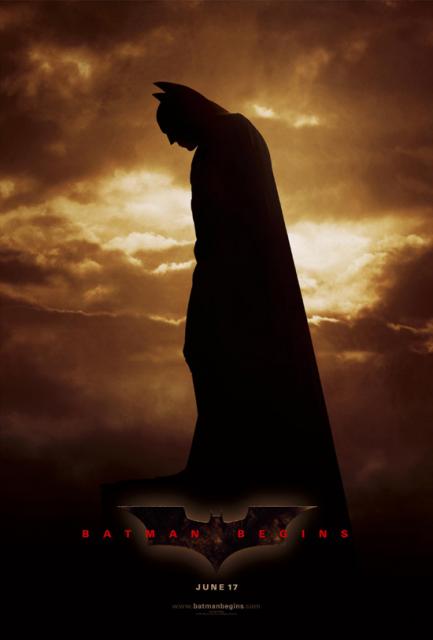
The following is a review Rekha and I wrote for the class. No, Batman Begins isn't a new film. No, this isn't a new review. Why post it? Because we can, and because we love it. The movie. The review. We love them both. And you should to. Here's why:


What is the difference between a man driven by justice and a man driven by revenge? Writer/director Christopher Nolan attempts to answer this question in his resurrection of the Batman franchise. Batman Begins does just what it says — it traces the birth of Batman out of the broken spirit of a young, parentless Bruce Wayne. Unlike the previous incarnations variously portrayed by Michael Keaton, Val Kilmer, and George Clooney, Christian’s Bale’s Batman is a profoundly realistic character.
Freed from the camp that has been the creative ethos of nearly every portrayal of the caped crusader, Nolan instead embraces the darker, more human side to Batman. What is particularly innovative about his approach is that we get a back-story for Bruce Wayne that does not feel at all contrived. The film begins with a series of flashbacks to Wayne’s youth, juxtaposing the horrifying murders of his parents with the anchorless and vengeful young man he has become.
At a mountain retreat in the Himalayas Wayne encounters Ra’s Al Ghuhl (Ken Watanabe) and the League of Shadows, a group devoted to the erradication of crime through vengeance. As he immerses Bruce in martial arts training, mentor Henri Ducard (Liam Neeson) presses Bruce to relive his worst fears in order “to become more than a man, to become a legend”. And in this fashion Nolan’s storytelling establishes Batman’s physical acumen even as Bruce Wayne learns to harness his fear and convert it in to something more productive.
Upon returning to Gotham, Nolan reveals the nuts and bolts behind Batman’s accoutrement with the help of beloved butler Alfred (Michael Caine) and Wayne Enterprises’ Applied Science guru Lucius Fox (Morgan Freeman), including the Batcave, the Batmobile, and the Batsuit. What follows is a web of crimes, masterminded by Gotham’s resident thug Carmine Falconi (Tom Wilkinson) culminating in a face off between justice and vengeance. Struggling to listen to his own better angels, Bruce attempts to right the system that produces the desperation that led to the murder of his parents. Forsaking the easy relief of revenge on Falconi, Batman maintains hope that the restoration of justice can redeem Gotham. Aiding his struggle are Police Officer Gordon (Gary Oldman) and lawyer and childhood friend Rachel Dawes (Katie Holmes).
Visually, this film departs from Tim Burton’s inaugural vision of Gotham as merely opaque, a comic book enviornoment that is both two dimensional and heavily framed. Nolan’s departure, while remaining dark, allows characters and locations the depth to resonate as actual people and spaces — instead of convenient fictions. For example, rather than a non-descript black hole, the Batcave is a cave, replete with dripping stalagtites and swarms of furry bats. This visual trick allows us to see the man of Batman and the world he inhabits beyond the legend we are so familiar with.
Nothing feels more innovative about this film than the choice to cast Christian Bale in the lead dual roles of Bruce Wayne and Batman, two entirely distinct physical presences. Bale’s face is all sharp angles and smooth planes, giving him the dignified appearance of the aristocrat Bruce Wayne was born to be (also on perfect display in the role of Patrick Bateman in American Psycho). But when his jaw juts outward and his cheeks furrow in, Bale transcends the physical limits of the suit to become the seething, revenge-bound man in black. Michael Keaton, as the original Batman, was an equally unconventional choice to play the leading man, but where he relied on costumes and brooding, Bale embodies the torturous psychology of both Wayne and Batman.
Few superhero movies and comic adaptations achieve the transcendent awesomeness that Batman Begins appears to do so effortlessly. It’s rare the film that is able to marry franchise filmmaking with the kind of directorial weight Nolan brings, particularly in the genre of noir, where he is clearly at his best. The wide appeal of Batman Begins is not to be underestimated—fans of Nolan’s earlier Memento will appreciate the film’s commitment to narrative and character while comic book fans will appreciate seeing a favorite hero reclaimed from camp. But perhaps most appealingly, Batman Begins taps into an American ideal that we all have the potential to be our best selves with a little introspection and a lot of money.

8.22.2006

When viewing pleasure matters.

I got to wondering recently about where I do my movie watching, and how much of a difference it makes to a movie watcher when the theater aesthetics are pleasing. So, I'm attempting a statistical breakdown here (and since my math skills are weak and i didn't actually attempt to tally numbers) it's more of an estimate.

In the last 5 years when I believe my movie watching skills have been honed and I'm proud to say diversified this is what my location breakdown looks like:

  • Corporate Theaters (i.e. Cinemark, AMC, etc.) 45% Most of these experiences have been good although some have better stadium seating then others, and most often have been over-air conditioned. However, despite that I probably experience my greatest rates of falling asleep in a movie in these conditions. Most recently, Superman and Miami Vice have fallen into this trap. Greatest advantage here is the double feature, which I haven't done in a while but it is one of life's greatest pleasures.
  • Semi-Corporate Indie Theaters (i.e. Landmark, Greenway, and the Alamo Draft House) 12% Okay, these have usually been very good experiences in terms of the actual movie, but these venues suffer from half assed corporate ownership thus no stadium seating and often too hot or cold depending on season although in Houston I would say it's always hot outside and too cold inside. The falling asleep rate here is good...it rarely happens as I often initiate these outings, and thus feel obligated to committ to the movie.
  • Full on independent theaters (only two that I've ever been to--both in Northampton) 5% These have been very positive experiences both in content and quality of viewing, which is interesting given the lack of resources devoted to viewing pleasure (definitely no stadium seating, or air flow of any kind here). But, these places have charm and that counts for a lot. Plus, while I've encountered a few obnoxious audience members nothing too bad, and nothing compared to the crowds you get at option #1.
  • And finally--the home viewing experience, which I give an A+ despite some potential pitfalls. 27% So, there are obvious reasons that home is good...the snacks are better and cheaper, I can talk whenever I want and not feel bad about it, and of course the pause button is essential here. Also, the whole falling asleep thing is not as much of an issue nor is it as socially awkward if it happens (and by socially awkward i mean when you hit the deep rem sleep and deep breathing, sounds, etc. follow). Just for the record I rarely hit that stage of sleep in a movie, but it has happened.

As far as rating my favorite experience in all of these settings I'm not sure I can although I find option #1 is best suited for movies full of fluff or action. So for example, Batman Begins is as good as The Princess Diaries to me thanks to the giant theater. Option #2 is best suited for more serious movies that you're willing to drive a little farther for, and if ambience is a factor. So, for example I owe my love for Life Is Beautiful entirely to the River Oaks Landmark theater. As for option #3 it encompasses my most recent experiences of which there have been many, but I think seeing Head On at the Academy of Music was pretty awesome even if it was with a bunch of crazy German Studies academics. Option #4 really has too many memories to recount so, I won't, and instead I'll just say that I love all the places that I've seen movies in, and in the vein of my new statistically savvy self they've all made my life at least 80% better.

8.11.2006

Making a political movie without politics (here's looking at you Oliver Stone)


Although I haven't actually seen World Trade Center I have read the reviews, which as far as I'm concerned is good enough. The glowing reviews are disappointing, but no less then what I exepcted from a public that is still not prepared to think about September 11th outside of the context of patriotism. But, as much as I don't like Oliver Stone, and never had high expectations for this I'm disappointed with amount of sapiness that that this movie just ooooooozes. I mean the guy is in now way subtle, as was proven by the uber bombastic Wall Street, but if you have a huge production budget and a major studio behind you, and you get to be one of the first to make a movie about an event that is both incomprehensible, and stained in our memories you better do better then this cheese fest. I think it's irresponsible filmmaking , or just a wasted opportnity depending on how much you value film culture.

It did remind me though of a great movie I saw this year that does deal with political issues in a heavy complicated way--Cache by Michael Haneke. I think the movie was more of an intellectual exercise then an interesting narrative, but I think it was incredibly powerful in how it handled national issues by bringing them into private domestic space. I also think the surveillance stuff was really creepy, and got right at the immigrant space in France in a way that was innovative. Of course the real difference between these two (Stone and Haneke) is that one understands nuance, but I also think that one is more honest and more interested in dissecting people, which ultimately is a much more satisfying experience for the viewer. Because really--what's the point in making a political movie if you're going to make it devoid of politics?

7.18.2006

Being a critic means never having to say I'm sorry...

There's a great article I came across in the NYT this morning written by A.O. Scott on the role of the film critic, and how to think about movies as vehicles of both art and commerce. I think it's one of the most fascinating divides in popular culture because movies are a medium that have become so accessible. With a combination of options from digital television, illegal and legal downloading, and just the overall increase of new products flooding new markets the demographic is changing. Where I think this gets really interesting is how it influences audiences comprised of people like me who are about equally engaged in reviews and movies.

"So we’re damned if we don’t. And sometimes, also, if we do. When our breathless praise garlands advertisements for movies the public greets with a shrug, we look like suckers or shills. But these accusations would stick only if the job of the critic were to reflect, predict or influence the public taste.
That, however, is the job of the Hollywood studios, in particular of their marketing and publicity departments, and it is the professional duty of critics to be out of touch with — to be independent of — their concerns. These companies spend tens of millions of dollars to persuade you that the opening of a movie is a public event, a cultural experience you will want to be part of. The campaign of persuasion starts weeks or months — or, in the case of multisequel cash cows, years — before the tickets go on sale, with the goal of making their purchase a foregone conclusion by the time the first reviews appear. Sometimes it works and sometimes it doesn’t, but the judgment of critics almost never makes the difference between failure and success... "

I think to an audience like us the cultural experience of the film is embedded into the discourse surrounding the film (i.e. who made it, their aesthetic choices, studio intrigue, etc.) I don't think films exist in that kind of vacuum anymore, and the proof is in websites like metacritic.com and rottentomatoes.com, both good at providing numerical breakdowns of judgment, and both popular with audiences who like going to the movies, but who claim not to be concerned with judgment.

"So why review them? Why not let the market do its work, let the audience have its fun and occupy ourselves with the arcana — the art — we critics ostensibly prefer? The obvious answer is that art, or at least the kind of pleasure, wonder and surprise we associate with art, often pops out of commerce, and we want to be around to celebrate when it does and to complain when it doesn’t. But the deeper answer is that our love of movies is sometimes expressed as a mistrust of the people who make and sell them, and even of the people who see them. We take entertainment very seriously, which is to say that we don’t go to the movies for fun. Or for money. We do it for you."

I guess the final point to make here is that critics exist where culture mattters, and even as that notion evolves, and the division between high and low brow is maintained I still like thinking that there are people out there doing the heavy lifting.